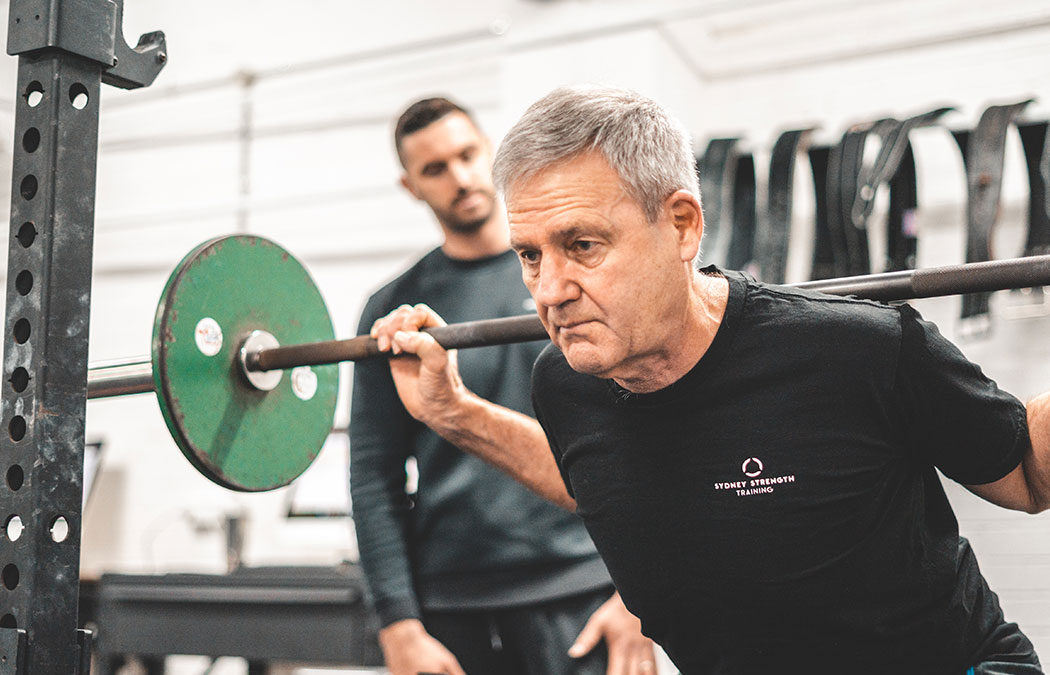
Squatting is part of everyday life. You may never put a barbell on your back. You may never do a powerlifting meet. But you still squat in some form when you get off the couch, rise from a chair, stand up from the toilet, pick something up, or lower yourself toward the floor. The movement pattern is everywhere. That is one reason squatting matters at any age. It is not just a gym exercise. It is a way of training the hips and knees to do the kind of work daily life already demands. We often hear people say they are “too old”, “too stiff”, or “too sore” to squat. But “squat” does not have to mean a heavy barbell back squat. It simply means some combination of bending through the hips and knees under load, even if it’s starting with bodyweight! In this article, we’ll cover what a squat is, what it trains, how the basic mechanics work, and what to do if traditional squats do not suit you right now.
What is a squat?
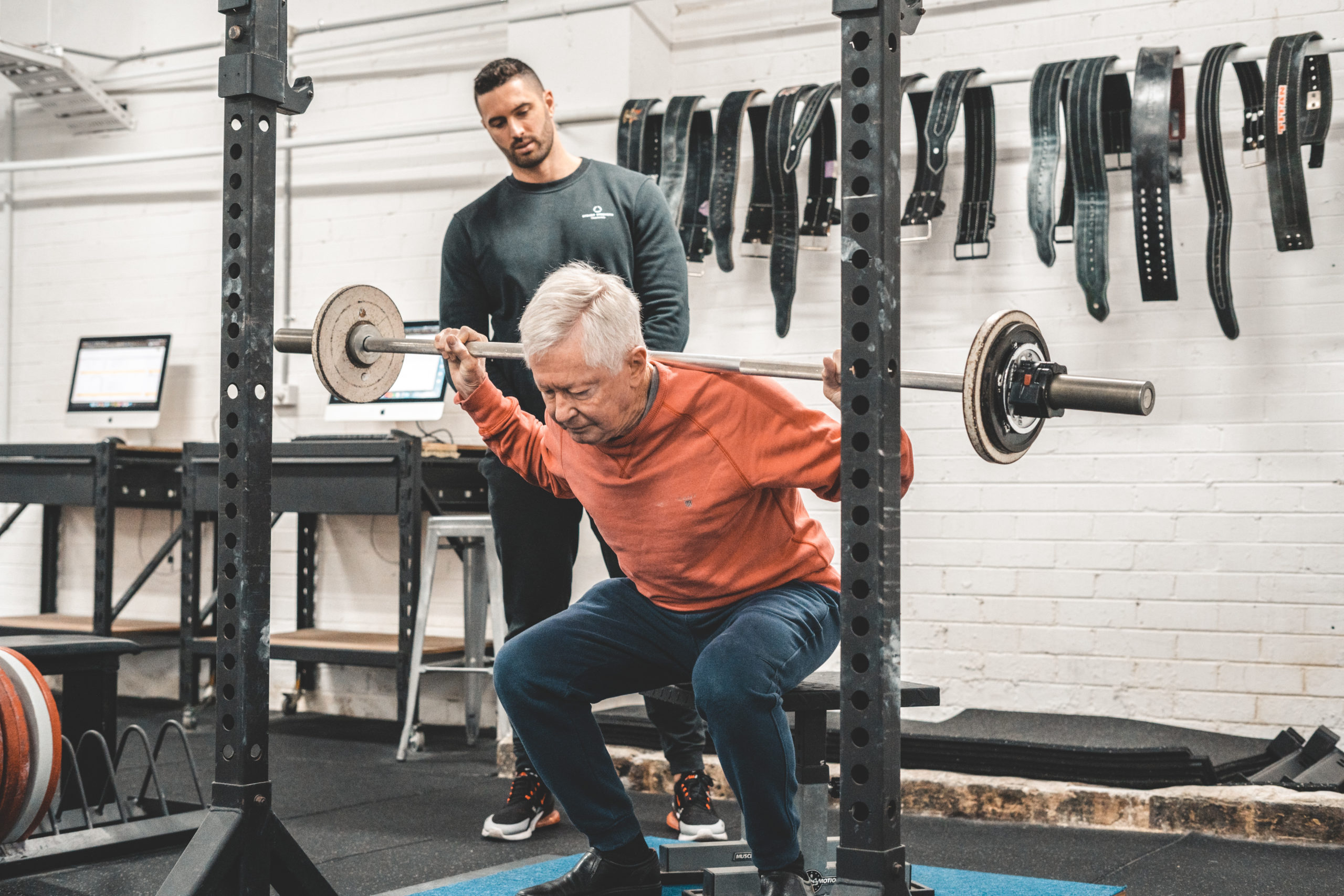
A squat is best thought of as a movement pattern rather than one specific exercise. In simple terms, a squat involves the hips and knees bending at the same time so the body lowers toward the ground, followed by extending those joints to stand back up. Simply put, sit down and stand back up again! Some squat variations also involve more forward trunk lean, different foot positions, or support from a machine, however the principles remain the same. This is why a bodyweight squat, goblet squat, leg press, hack squat, split squat, and barbell back squat all belong to the same broader family. They are not identical, but they load similar regions and train a similar pattern. That is also why the “best squat” question often misses the point. The best squat is usually the one that fits your goal, current abilities and available equipment.
What muscles do squats train?
Squats mainly train the quadriceps, glutes, and adductors. Or in less technical terms, your bum and thighs! Here’s what they each do individually:
- The quadriceps help extend the knee.
- Glutes work hard to extend the hip.
- Inner thigh muscles also known as adductors, also contribute strongly to hip extension as well.
- Depending on the variation, the calves, trunk, and spinal erectors may also work hard to help stabilise the body under load.
The hamstrings often get mentioned here, but this is where people can get confused. While the hamstrings cross the hip and knee, they cannot meaningfully create force in the squat in the same way they do in hinges like Romanian deadlifts. Because the hamstrings cross both the knees and hips, changes at one joint can offset changes at the other. That means they tend not to get challenged in a squat to the same degree as the quads and glutes. So when people say squats are a great lower-body exercise, that is true. But more specifically, they are an efficient way to load the front and middle of the thigh, the hips, and perhaps muscles used to help someone straighten their torso up under load.
Why squats matter for health and function
Squats matter because lower-body strength matters. The ability to stand up, sit down, climb stairs, carry yourself, and recover your balance all depend heavily on the muscles around the hips and knees. Resistance training improves strength and physical function across the lifespan, and lower-body strength is especially relevant for maintaining independence as we age. The squat is simply a time-efficient way to challenge the legs and hips through a movement pattern people already use. That is also why squatting can be “functional” without being magical. It does not recreate every task in life, but it trains qualities that support many of them: force production, control, balance, coordination, and confidence under load.
How squat mechanics work
At its core, a squat is a balancing act. As you lower, the hips and knees bend while your centre of mass stays roughly over the mid-foot. How that looks can vary. Some people squat more upright with greater knee travel, while others use more hip flexion and trunk lean. Load also changes the movement. A goblet squat can help keep the torso upright, while a barbell back squat demands more coordination and trunk stiffness. Machines like hack squats or leg presses reduce the balance requirement and allow you to focus more directly on the legs. There is no single perfect squat style, instead just principles and individual variation. Resistance training broadly improves strength and functional capacity, which is what matters most in practice ¹.
A lot of people say, “I can’t squat,” when they really mean they can’t tolerate one version. That distinction matters. If a full squat is difficult, raise the target to a box. When balance is limited, try holding onto a support. If something feels irritated, reduce range and/or intensity and build back up. Goblet squats, split squats, or machines can all be effective alternatives. At Hobart Strength Training, we like the back squat because it’s efficient and scalable, but it’s not mandatory. The goal is simple: find a variation you can perform consistently, load progressively, and use to build strength over time.
Squat alternatives count too
If you cannot or do not want to back squat, there are plenty of alternatives that still train the pattern well. These include:
- goblet squats
- front squats
- split squats
- reverse lunges
- step-ups
- hack squats
- leg press
- box squats
- sit-to-stand variations
Each has strengths. A goblet squat is often a great teaching tool because the front load can help with balance and torso position. Split squats and lunges can reduce the demand on each limb at once while still training the hips and knees hard. Machines can provide support and allow people to challenge the legs even when balance or coordination is a limiting factor. Sit-to-stands are an excellent entry point for people returning to exercise or rebuilding capacity. If the goal is to load the legs and hips, there are many roads to Rome.
Conclusion
Age alone is not a reason to avoid squatting. In fact, avoiding lower-body training altogether often creates bigger problems over time. Muscles, tendons, and bones respond to loading. The key is simply matching the exercise to the person. For some, that might mean chair squats or step-ups. For others, goblet squats or barbell variations. It doesn’t need to look impressive to be effective; it just needs to be repeatable, appropriately challenging, and progressed over time. You are already squatting in everyday life. Training the pattern in the gym gives you the opportunity to do it with more strength, control, and confidence. If your goal is to be Stronger For Life, some form of squatting belongs in your program. If you’re based in Hobart and want help finding the right approach for you, reach out to our team at Hobart Strength Training today.
References:
- https://pubmed.ncbi.nlm.nih.gov/19588334/