Injuries are frustrating. Whether you’ve strained a muscle, irritated a tendon, or tweaked your back, it’s natural to wonder whether you should stop exercising altogether. The good news is that many injuries do not require complete rest. In fact, appropriate exercise is often an important part of staying active, maintaining fitness, and returning to normal function. The key is finding the right amount and type of training for your current situation. In this article we’ll discuss the following:
- what is an injury
- Can you exercise while injured?
- How can you exercise while injured.
Whether you’re currently nursing an injury, or debating whether or not exercise is worth there risk, this article is essential reading.
What is an injury?
When most people think about injury, they picture damage to a muscle, tendon, ligament, joint, or other body tissue. In a musculoskeletal sense, an injury is usually something that causes pain, limits movement, or reduces your ability to perform normal activities or training. Not every ache or pain automatically means significant damage has occurred ¹. Training itself creates fatigue, soreness, and temporary discomfort. However, when symptoms begin affecting your ability to train or function normally, it may be worth adjusting your exercise program and seeking professional advice if needed. Injuries aren’t definable alone by pathology, but in tandem with impact on day-to-day life, and the activities that are meaningful for an individual.
Can you exercise while injured?
In many cases, yes.
One of the biggest misconceptions surrounding injury is that all exercise should stop until symptoms completely disappear. While some injuries require short periods of rest or medical management, many people benefit from continuing to move and train within their current capabilities. Research consistently shows that resistance training is remarkably safe and that the risks associated with inactivity often outweigh the risks of appropriately prescribed exercise ².
This does not mean ignoring pain and pushing through at all costs. Instead, it means finding productive ways to stay active while respecting the body’s current limits. This might mean modifying tempo, range of motion, load and exercise selection for resistance training. For cardiovascular conditioning it could involve pace, distance, total time and also impact (running versus cycling).

How can you exercise safely while injured?
The goal is rarely to stop training. The goal is to modify training.
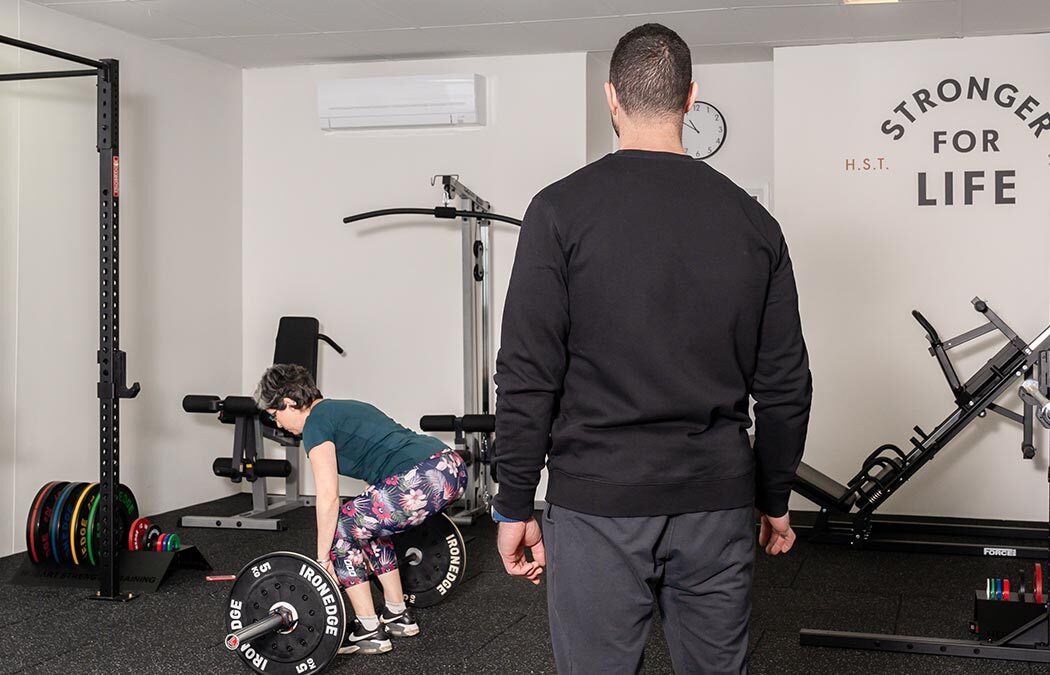
As aforementioned, this might involve reducing load, performing fewer sets, changing the range of motion, slowing the movement down, or selecting a different exercise altogether. For example, someone with shoulder pain may temporarily use different pressing variations, while someone with knee pain may adjust squat depth or training volume.
Some typical choices might include:
- swapping to low bar box squats from deep front squats to reduce knee loading
- Changing out to Dumbbells and modifying grip angle to vary the stress at the shoulder
- Using block pulls with the lower back is sensitive to deeper degrees of flexion
Importantly, some increase in symptoms does not always mean further damage is occurring. Pain is a complex protective mechanism influenced by many factors, including stress, fatigue, previous experiences, and beliefs about injury ³, ⁴. Finding the correct training dose allows many people to maintain fitness, confidence, and function while recovering.
Our role as Coaches
At Hobart Strength Training, our role is not to diagnose injuries, replace medical care or prescribe unnecessary mobility and movement drills to “restore function”. Our role is to help people continue training safely within appropriate boundaries. That means meeting you where you are, modifying exercises when necessary, and gradually rebuilding your capacity over time. We understand that setbacks can be discouraging, but we also know that the human body is highly adaptable and resilient. Rather than viewing injury as a reason to stop exercising altogether, we view it as an opportunity to find the right entry point and keep moving forward. It’s also very healthy during injuries to pivot goals. Just because a knee might be sore, that doesn’t mean you can’t work on your chin-up strength!
So, can you exercise safely while injured?
For many people, the answer is yes. The key is choosing the right exercises, managing training load appropriately, and adjusting the program to suit your current capabilities. If you’re dealing with an injury and aren’t sure how to train around it, our coaches can help you stay active, maintain progress, and work toward returning to full training with confidence. Reach out to our team today and start feeling Stronger, For Life.